The Complete Guide to At-Home Blood Testing in Bangkok: What to Test and Why
At-home blood testing in Bangkok brings a phlebotomist to you, tests the markers that actually change decisions, and has a doctor read them. Here's what to test and why.
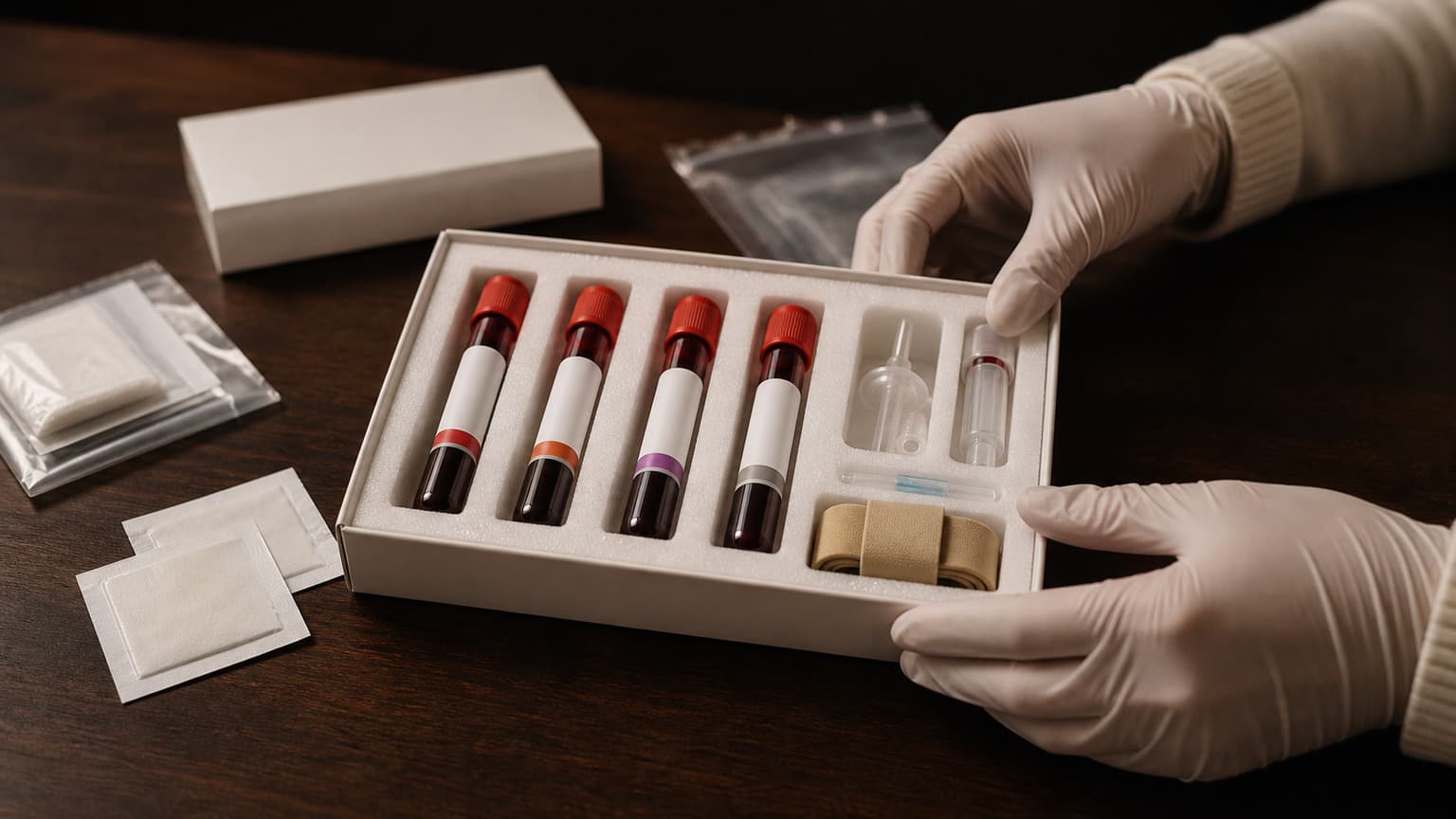
A standard annual checkup in Bangkok will tell you your cholesterol and your blood sugar. It usually won't tell you your , your , your inflammation, or how your hormones are tracking — the markers that move first and quietly. At-home comprehensive testing closes that gap, and it does it without a half-day at a hospital.
What is at-home blood testing and how does it work in Bangkok?
At-home blood testing is a service where a trained phlebotomist comes to your home or office, draws blood, and sends it to an accredited lab — so you skip the clinic queue entirely. In Bangkok the typical flow is simple: you book a fasted morning slot, the phlebotomist visits, results come back from the lab in around 48 hours, and a clinician reviews them.
The convenience is real, but the more important difference is what gets tested and who reads it. A comprehensive panel covers far more than a basic checkup, and at Orba a licensed physician reads every first draw personally rather than handing you a printout with reference flags and no interpretation.
Which biomarkers should a longevity blood panel test?
A longevity-focused panel tests across five systems — metabolic, cardiovascular, hormonal, inflammatory and organ function — because no single marker captures how you're ageing. The goal is to find drift early, while it's still reversible with lifestyle rather than medication.
| System | Key markers | Why it matters |
|---|---|---|
| Metabolic | Fasting insulin, glucose, HbA1c | Insulin resistance can precede diabetes by 10–20 years while glucose still looks normal. |
| Cardiovascular | ApoB, LDL-C, HDL-C, Lp(a), triglycerides | ApoB counts the actual atherogenic particles — a more accurate risk marker than LDL-C alone. |
| Inflammation | hs-CRP | An independent predictor of cardiovascular events, even when LDL is low. |
| Hormonal | Thyroid (TSH, free T3/T4), testosterone, vitamin D | Drives energy, mood, body composition and recovery; often missed in basic checkups. |
| Organ & blood | Liver, kidney, full blood count | Baseline organ function and the components of blood-based age clocks. |
Two of those deserve emphasis. ApoB is increasingly treated as the better cardiovascular-risk marker than because it counts the number of atherogenic particles directly. And fasting insulin catches metabolic trouble far earlier than the most checkups stop at.
How is at-home testing different from a hospital checkup?
The biggest differences are breadth, interpretation and benchmarking — not just where the needle goes in. A hospital package checks whether you're sick today; a comprehensive longevity panel checks how well you're ageing and whether your trajectory is heading the right way.
| At-home longevity panel | Typical hospital checkup | |
|---|---|---|
| Location | Your home or office | Clinic / hospital, in person |
| Marker breadth | Comprehensive, across 5+ systems | Core safety markers |
| Ranges used | Optimal ranges | Broad lab reference ranges |
| Interpretation | Physician read + coaching | Flags only, often no context |
| Goal | Optimise & track over time | Detect existing disease |
That benchmarking point matters more than it sounds. A result can sit inside a lab's broad "normal" range and still be far from optimal — Orba scores each marker against the optimal ranges the evidence supports, not just the wide intervals designed to catch overt disease.
How much does a comprehensive blood panel cost in Bangkok?
A comprehensive at-home panel in Bangkok costs more than a basic clinic blood test but far less than a full hospital executive package — and what you're paying for is breadth, the at-home draw, and a physician's read rather than a printout. Orba starts at ฿14,900 for a baseline, with options that include repeat testing across the year so you can see markers actually move.
The value question is best framed as cost per decision changed. A cheap panel that tests too few markers, uses broad ranges and comes with no interpretation can cost you more in missed signals than a comprehensive one. See what each tier includes to compare like with like.
Not sure which markers you need? Build a panel around your goals — metabolic, cardiovascular, hormonal or full longevity — with a physician reviewing the result and a coach turning it into a plan.
Build your panel →How do you prepare for an at-home blood test?
For most longevity markers you fast for 8–12 hours and book a morning slot, because fasting glucose, insulin and lipids are all read against fasted reference values. Drink water — hydration makes the draw easier — and avoid intense exercise and alcohol the day before, since both can transiently shift markers like and liver enzymes.
- Fast for 8–12 hours (water is fine) and book a morning draw.
- Stay hydrated — it makes the venipuncture quicker and cleaner.
- Skip intense training and alcohol for ~24 hours beforehand.
- Keep timing consistent between tests so results are comparable.
Key takeaways
- At-home blood testing in Bangkok brings a phlebotomist to you for a fasted morning draw; results return in about 48 hours and a physician reviews them.
- A longevity panel tests metabolic, cardiovascular, inflammatory, hormonal and organ markers — far more than a basic checkup.
- ApoB and fasting insulin catch cardiovascular and metabolic risk earlier than the LDL and glucose most checkups stop at.
- Comprehensive panels are scored against optimal ranges, not just the broad lab reference intervals built to catch overt disease.
- Prepare by fasting 8–12 hours, hydrating, and keeping timing consistent between tests so results are comparable.
Frequently asked questions
A trained phlebotomist comes to your home or office for a fasted morning draw, the sample goes to an accredited lab, results return in about 48 hours, and a clinician reviews them. You skip the clinic queue entirely.
MD · Licensed physician (Thailand)
Zethapong Nimmanterdwong is a physician licensed in Thailand and the doctor who reads every first blood panel at Orba personally. He translates dense lab reports into plain-English decisions clients can act on, benchmarks results against optimal ranges rather than the lab's broad reference intervals, and is the clinician in the loop behind every Orba recommendation.
View full profileKeep reading
 Blood Testing
How to Choose a Blood Panel in Bangkok (2026)
Dan's guide to which markers earn their slot, which ones don't change anything, and the questions every clinic should answer.
 Longevity
Biological Age vs Chronological Age: A Blood-Test Guide
Chronological age counts birthdays. Biological age measures how fast your body is actually wearing — and it predicts disease and death far better. Here's how a blood test reads it.
 Metabolic Health
Metabolic Health Explained: The Markers That Predict
Metabolic health is how well your body manages energy — and most adults are quietly losing it. Here are the blood markers that flag it years before a diagnosis.